FdSc Canine and Feline Behaviour and Training*
*subject to validation
Course Details
-
Subject Areas
Animal Management -
Qualification
Level 5 -
Course Type
Full Time -
Length
2 Years -
Location(s)
York
Course overview
Delve into the captivating world of canine and feline management with our Foundation Degree in Canine and Feline Behaviour and Training programme. Designed to help prepare you for a rewarding career in the animal industry, this comprehensive course focuses on the skills and knowledge essential for working with our beloved four-legged companions.
UCAS Code
C865
Awarding Body: Askham Bryan College
Please note, this course is now closed for 2026/27 applications including via clearing, however you can start your application for Sept 2027 start.
Centre Code
A70
What you will learn
From understanding behaviour and welfare needs to mastering the art of training and managing cats and dogs, our programme covers all aspects crucial for success in this industry. With a strong emphasis on practical skills and critical thinking, we support you to become a confident and independent professional, equipped with specialist knowledge that can set you apart in the industry.
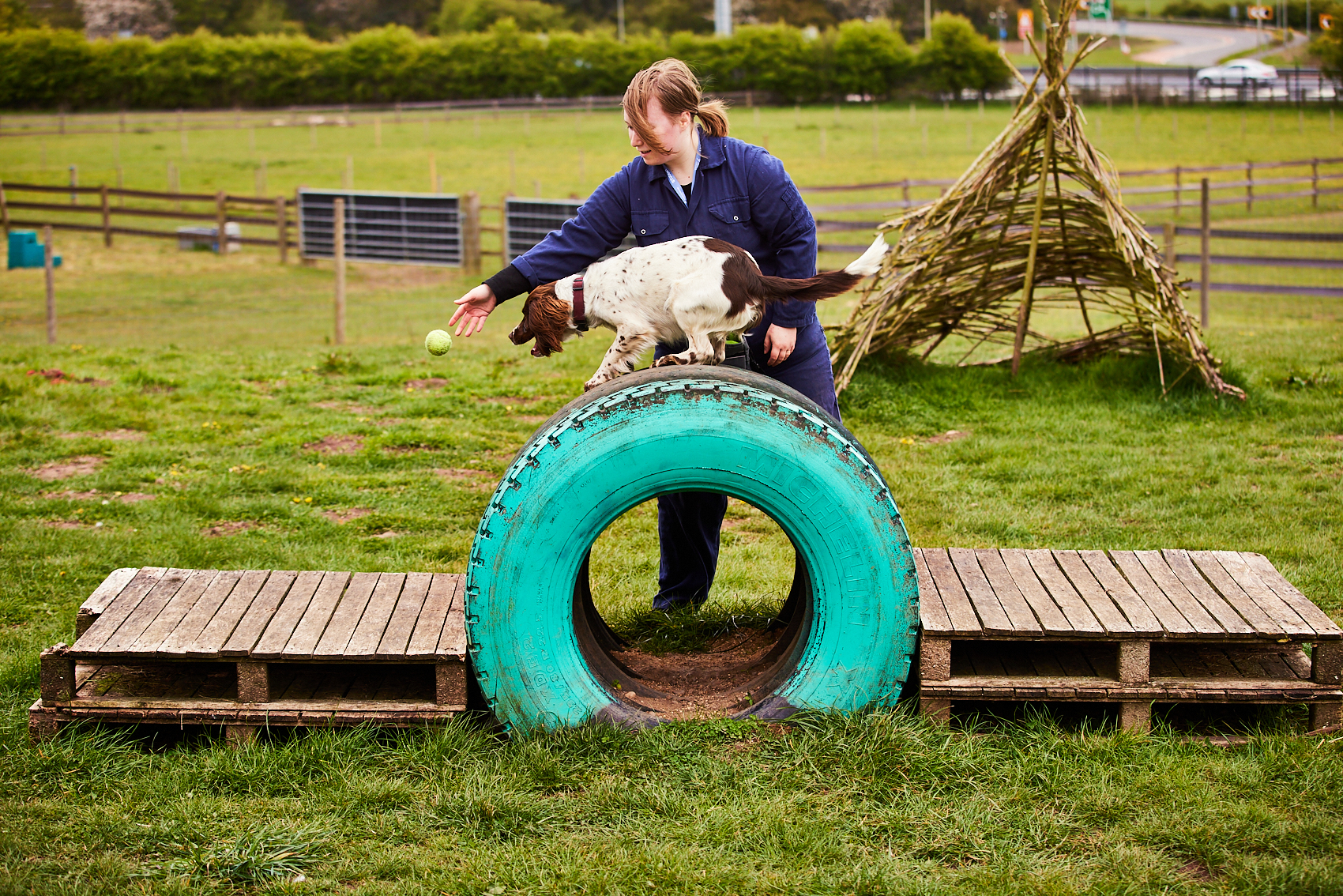
Immerse yourself in real-world learning experiences through applied work placement, including hands-on training in our commercially licensed kennels and cattery. Our facilities provide a nurturing environment where you can develop and hone your skills whilst working with diverse range of breeds.
At University Centre Askham Bryan, we don’t just teach; we provide opportunities for you to demonstrate and apply your knowledge in a practical setting. This course could unlock your potential to make a meaningful difference in the lives of companion animals.
This course is 2-years full time (part-time study may also be available – contact he@askham-bryan.ac.uk for more information about part-time study).

PROFESSIONAL RECOGNITION ARRANGEMENTS**
This programme has been mapped to the Animal Behaviour and Training Council (ABTC) Knowledge and Understanding Standards (KUs) and is a recognised qualification by ABTC.
KU Standards Met: Any student who achieves all KU criteria will receive a professionally recognised qualification, leading to opportunity for them to apply to enter the ABTC practitioner register.
KU Standards Not Met: Any student who does not achieve all KU criteria after all permitted reassessment attempts, will not receive a professionally recognised qualification. This does not impact on the student being able to attain their FdSc qualification and they may still be able to apply for ABTC practitioner status, via an alternative process provided by ABTC.
The student is responsible for any application made to ABTC for practitioner registration and is independent of the College.
The status of any professional recognition will be reported on a students final award transcript.
Further information regarding ABTC can be found here – ABTC – Animal Behaviour & Training Council
**subject to renewal
UCAS Year of Entry
Year 1 (Level 4) Core Modules include
- Applied Health and Husbandry*
- Canine and Feline Welfare*
- Human and Animal Cognition
- Biological Basis of Behaviour*
- Academic Writing and Research
- Canine and Feline Behaviour*
* Denotes modules as recognised as meeting the Knowledge and Understanding requirements for the Animal Behaviour and Training Council (ABTC) roles of Animal Training Instructor (ATI) and Animal Behaviour Technician (ABT).
Year 2 (Level 5) Modules include
- Theory of Animal Training*
- Applied Animal Training*
- Dog School Instructing*
- Problem Behaviour Management*
- Human – Animal Bond*
- Independent Research Project*
*Denotes modules as recognised as meeting the Knowledge and Understanding requirements for the Animal Behaviour and Training Council (ABTC) roles of Animal Training Instructor (ATI) and Animal Behaviour Technician (ABT).
Depending on the level of study students are expected to engage with a minimum of 15–20 hours per week for full-time study (including scheduled contact time and independent learning).
Minimum attendance requirement: 75% of scheduled sessions where attendance is required.
Engagement includes:
- Attending teaching sessions (face-to-face, online, or blended)
- Completing and submitting work by deadlines
- Attending tutorials, project supervision and dissertation meetings
- Participating in group work, placements, and mandatory field trips
Please see the Attendance Policy and Procedure for further details.
Programme Specification
Programme Specification FdSc Canine and Feline Behaviour and Training 2025
Key Information
Applicants should have achieved:
- 64 UCAS Points
• 5 GCSE’s including Maths English and Science at Grade C/4 or above. Equivalent qualifications may be accepted in lieu of GCSE’s. Applicants must have successfully completed a full Level 3 study and/or have significant industry experience.
Some students may be asked to attend an interview.
Applicants who believe they may be eligible for Accreditation of Prior Certificated and/or Experiential Learning (APCL/APEL) will be considered on an individual basis.
If you have any queries in relation to entry qualifications, then please contact the University Centre directly.
On successful completion, students may wish to consider progressing onto the BSc (Hons) Canine and Feline Behaviour and Welfare top up, allowing students to graduate with a BSc (Hons) degree.
Students studying the course may enter a wide variety of roles in the industry. This includes animal trainer, animal behaviourist, kennel and cattery management, animal charity work and or animal nutritionist
UK, Isle of Man and Channel Isles Students on BSc Honours Degree/ BSc (Hons) Top up/ Foundation Degree/ Extended Foundation Degree/ Certificate of Higher Education Fees:
2025/26 = £9,000 per academic year
2026/27 = £9,525 per academic year
2027/28 = £9,525 per academic year
Please note that the fee status of each applicant will be assessed prior to any offer being made (Home Fee or Overseas/International Fee). Where required further information may be requested ensure the correct fee status is allocated. For further information about on studying in the UK and fee status, please visit UKCISA
Non-Home (Overseas Students) on Honours Degree/ Foundation Degree/ Extended Foundation Degree/ Certificate of Higher Education Fees:
2025/26 = £14,000 per academic year
2026/27 = £14,500 per academic year
2027/28 = £14,500 per academic year
Fees are charged per academic year of the course. Please note that is any restudy is required there will be tuition fees associated with this. Please refer further guidance and information on tuition fees and additional costs – Student Finance
Tuition fees are subject to an annual inflationary rise as per government guidance.
This programme requires students to undertake 300 hours of work placement across the 2 year programme. Work placement is completed with an external provider which is arranged by the student.
All work placements are subject to a health and safety check by the college to ensure that placements are suitable and safe. Support can be made available via the module tutor to help locate a suitable placement.
If you are already working in the sector, it may be possible to APEL (Accreditation of Prior Experiential Learning) this element of the course. Evidence of such employment will be needed, outlining duties etc for consideration at the APL panel, where applications will be considered on an individual basis. If you have any queries in relation to this, then please contact the University Centre team directly.
University Centre Askham Bryan fosters diverse talents and skills through a range of engaging assessment methods tailored to hone industry standard subject skills, as well as transferable skills and graduate attributes. From traditional coursework to time-constrained assessments that sharpen quick thinking, with each assessment opportunity you can showcase your abilities.
Engage in online assessments blending technology with information for adaptable problem-solving. Whilst presentations amplify your voice, and scholarly viva-voce discussions deepen understanding. Practical assessments bridge theory with real-world application, helping to shape your subject expertise.
With our varied approach, learning isn’t just about meeting standards—it’s about discovering your potential within an educational landscape.
In addition to tuition fees and accommodation if applicable, students will need to budget for extra costs as part of this course and will be responsible to cover them. Below is a link with approximate cost to help with your budgeting.
Meet the staff